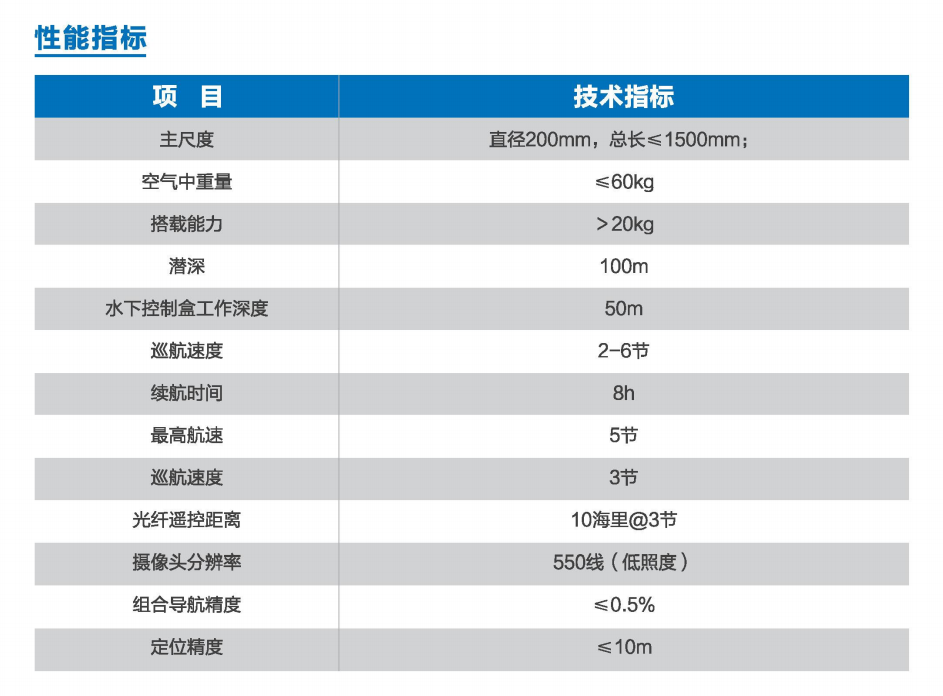
Product Introduction The YFMC200 Portable Autonomous Underwater Vehicle adopts a modular design. It integrates core modules with fully independent intellectual property rights in an allinone manner, including an autonomous driving unit, highprecision navigation module, highdefinition imaging sonar and newtype thrusters. Featuring autonomous navigation and intelligent operation capabilities, it can be carried and operated by two personnel, and is capable of performing tasks such as marine environment monitoring, underwater target search and positioning, highdefinition marine exploration, as well as inspection of oil pipelines and submarine cables.
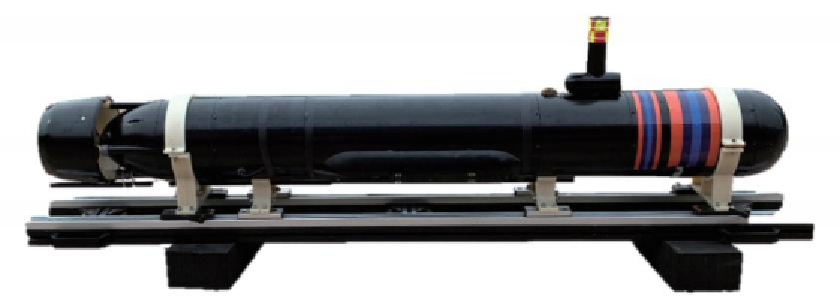
It supports two operating modes: fiber-optic remote control and autonomous navigation.
The camera of the underwater observation robot enables surface monitoring and auxiliary underwater optical observation in clear water. It can transmit video data to the underwater control box in real time via optical fiber for display.
It possesses a certain load capacity.
It is capable of depth adjustment and depth maintenance during both hovering and navigation.
The underwater observation robot is equipped with sensors including dualfrequency forwardlooking imaging sonar, depth sensor, underwater camera, Beidou system and fiberoptic inertial navigation system (for measuring attitude, angular velocity and acceleration) as well as Doppler velocity log (for measuring speed). It can also be expanded to carry BP modules and side-scan sonar modules.
The underwater control box can control the underwater observation robot, as well as monitor and record the robot's operating status, video footage and sonar images.
It is equipped with path planning and automatic collision avoidance functions.
A recovery module with positioning function is configured.
The data storage capacity of the control box is sufficient to record all operational data of the underwater observation robot throughout its working process.
When the AUV loses communication with the underwater control box, it will return to the preset recovery position. If it is not recovered on schedule, it will perform timed selfdestruction. Remote selfdestruction can also be triggered via the underwater control box. The AUV itself is designed with surface-emergency selfdestruction function. Selfdestruction refers to burning key information and electrical components followed by self-sinking.
The AUV is fitted with an anti-frogman detection sonar.
The battery module is compatible with primary batteries and secondary batteries.
The overall AUV features low magnetism.
Application Fields
● Marine Environmental Monitoring
● High-Definition Marine Exploration
● Underwater Imaging and Search
● Topographic and Geomorphological Mapping
● Intelligence, Surveillance and Reconnaissance
● Maritime Security